Monday, November 19, 2012

Yesterday, in the city of Agrinio


"You have to deeply understand fascism, it won't die by itself, SMASH IT" (a banner at the beginning of the antifascist gathering in the city of Agrinio) 
..the clashes lasted until late Sunday night


Yesterday, in the city of Agrinio (a city between Patras and Ioannina), took place an antifacist action of 300 people against the new offices of Golden Dawn. The protesters clashed with the riot police, that answered with tear-gas.


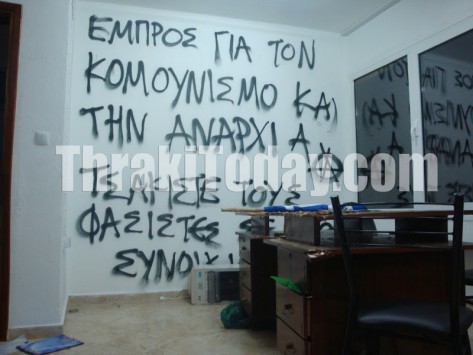
The previous night, there were also various attacks at the offices of the nazi party Golden Dawn in the city of Xanthi (Thrace) and Karditsa (Thessaly).

"for communism and anarchy, smash fascists in every neighborhood" (a wall at Golden Dawn's offices in the city of Xanthi after the attack)


Monday, November 12, 2012

The new measures package


The new measures package


On Wednesday 7th of November the Greek parliament voted for the new austerity measures package. It is almost impossible to describe in detail all these measures and their impact on Greek people 's life even in broad outline but generally speaking we could say that by including a lot of redundancies, further decrease of salaries, pensions and benefits, they bring down whatever remains standing after three years of austerity.

The age of retirement raises by 2 years which means that the majority of the workers will go into retirement at 67 years old even those who are ready to be retired next year. They cut down all pensions by between 5% and 15% and they cut out the Christmas and Easter bonus for all pensioners and public servants too. Depending on the case, the working sector and conditions, they either cut down or even stop welfare state benefits, such as unemployment, poverty, family/child care and even handicap benefits.

They also introduce a retrospective change in the national agreement of labour which has been called anti-constitutional by a specialist committee of the parliament itself but that seems not to bother the government. According to this change the minimum wage will be frozen and from now on will be regulated by the minister of labour itself, there will be no increase for anyone to the scale of payments, the  employers will have the right to give shorter notice before discharge, lower redundancy pay, lower contribution to the pension and health funds and the working hours also will depend on their will. Finally the employers are not obliged to follow the national agreement if they do not want to sign it!

There are also further increases in indirect taxes, measures against the income of farmers, redundancies in the public sector and total flexibility of the public servants. The package contains further privatization of the public sector, enforcing also further privatization of hospital treatment which includes a price for hospital admission (a patient who will need to be admitted to a hospital will have to pay 25 Euro just to start with). This, for a country with more than 30% unemployment, means that thousands of people will not be able to afford medical treatment.


Greece, November 6th and 7th: General strike

A 48-hours general strike was called in Greece by the general confederation of the Greek unions for 6th and 7th of November.

On Tuesday 6th of November, first day of the general strike, a few thousand people gathered in the morning at the strike demonstration gathering point at the national museum near to the Polytechnic school. It seems that the strikes in the transportation sector and the continuous general strikes during the last period prevented people from attending. Despite the presence of a lot of riot police squads, undercover policemen and motorcycle police units in most streets and side-streets leading to Syntagma square, demonstrators marched toward the square and they filled it until 1 o' clock when they started to leave the place. It was a quiet and quite disappointing day of strike!

On the second day things seem to be different. There were several calls for gathering outside of the parliament in the afternoon when the measures package will be voted. Plenty of strikers have been detained by the police as its units attacked and blocked demonstrators who were trying to go to the gathering point. Additionally metro stations in the center of Athens were ordered closed by the police and policemen on several occasions made preemptive detentions, in order to prevent demonstrators from reaching syntagma square.

Despite the police mobilization at least 100.000 demonstrators managed to gathered at 18:30 in front of or next to the Greek parliament. At 19:00 demonstrators started pushing the metal fence and the barriers which protected the parliament and as soon as they managed to destroy a small part of it riot police units attacked people. Molotov Cocktails (petrol bombs) were thrown by the demonstrators in order to defend themselves from police attacks. Huge amounts of teargas and stun grenades were used by riot police squads in order to force demonstrators to abandon the square. But people wanted to stay in the square and they regrouped again every time they were forced to disperse by the teargas. The pressing from demonstrators was so  intense that police officers decided to use water canons for the first time against people during a strike.

There were clashes outside the parliament and around syntagma square for hours until the rain started. It was amazing to see that people did not want to leave the area! But the combination of the teargases with the rain turned the whole area into an unbearable field for the majority of the demonstrators. Most of them started to leave under the continuous attacks by the riot police squads. As the blocks of strikers were leaving the area, police units attacked, causing a lot of people to be wounded. There were reported at least 40 injuries, some of them helped by striking doctors and nurses in a kind of DIY health clinic inside a hotel in the area.

After a final attempt to re-take syntagma square, riot police units finally cleared the area from the strikers under heavy rain around 10:00. There were reported to be 103 detentions, 5 arrests, at least 40 injured demonstrators and 7 injured policemen.

The package of severe austerity measures has passed through the parliament  after a midnight vote.  


group of libertarian communists

Athens

Thursday, November 8, 2012

About yesterday in Athens


Cops with APCs, with chemicals, with guns, with motorcycles. At the
same time that inside, Parliament voted for the slashing of wages and
pensions, for the dismissal of thousands of people and many other
shameful things (in a shameless manner), outside another giant police
operation of repression unfolded against the demonstrators. Even in
the rain, the cops choked Syntagma Square in tear gas to disperse the
protesters who had remained. For all that, the state certainly has
money. It has money to enforce a police state in the streets. It has
money to purchase tons of chemicals and APCs. It has money to armor
like lobsters the special units of repression.
As long as people are not willing to lose even one day's wages, to
risk two or three most basic things, then their misery, physical and
moral, is certain. This whole system of suppression, the spraying with
tear gas, the cordoning of the streets around the Constitution by riot
police lined like laces, is aimed at nothing more than to force us to
stoop our heads and shut up. Its aims are that we empty the streets,
stay at home immersed in depression, or head to the mountains, or
board a plane and emigrate.
But this place does not belong to them. The struggle for this land and
its freedom is a struggle that we have been fighting for years now. No
matter how many cops they put up, this struggle is not going to stop.
No matter how many measures they take, how many electoral backstops
they have in parliament, nothing is finished, and nothing will end the
way they want it.
We have nothing else to do than to give a way to rage, as a recent
anarchist slogan goes in an athenian street ...

Saturday, October 27, 2012

NO to Golden Dawn

Comrades from U.S. have sent us this piece about the gatherings that have taken place in New York over the past weeks, in order to discuss the ways to fight Golden Dawn, which recently announced it was opening an office in Queens. We post it here, and we will soon have a translation of it in Greek. 


Golden Dawn, the Neo Nazi party that captured a sizable parliamentary presence in Greece, while terrorizing and beating immigrants, radicals, gay/lesbian/trans people and others, announced some weeks ago it was opening an office in Queens. The intention was to build support among the borough’s sizable diaspora community. With this came the launch of www.xanyc.com -- a site devoted to Golden Dawn's operations in New York#. Soon thereafter the Ku Klux Klan issued a statement welcoming the party's US arrival, and white supremacist sites across the country have been aflutter with praise for the group's internationalization. Similar reports of attempts to set up offices in Melbourne and Montreal have also occurred. By all indications, the eastward transatlantic migration of emergent European fascism is both a possible harbinger and gruesome vignette most had resigned to the rear view. Within hours of the Golden Dawn announcing plans to open an office in New York, hundreds began organizing to prevent it. So far, these mobilizations have been successful. This article will delve into some of the organizing that has been taking place in New York, locate this in the recent political movements of the past year and point to some of the challenges that have emerged between new political practices and more traditional forms of organization.

Over the past weeks an eclectic spectrum of New Yorkers have been gathering in each of the boroughs, from Manhattan cafes and the lounges at the City University of New York, to Brooklyn apartments, as well as parks and church basements in Queens. Often as relative strangers, people are coming together to discuss strategy and plan action. Turnaround has been swift. Flyers went up denouncing the organization and warning residents of its presence. Hackers allegedly affiliated with Anonymous disabled the fascists’ website and phones. And local politicians staged a press conference denouncing Golden Dawn's presence in Queens. Through conversations with the community center that first agreed to host Golden Dawn in Astoria, local residents and allied organizers were easily able to convince the center not to allow them to use their space. (The community center made clear that they did not understand who the group was since they entered under the pretext of fundraising for Greece, and did not reveal their political agenda.)

With less than a week for outreach, over 200 people gathered in a local Astoria church for the first collectively called public meeting against Golden Dawn. This first meeting was organized by some people in the local Greek community, a recently-formed Greek Left alliance known as Aristeri Kinisi, Occupy Astoria-Long Island City, and other Occupy groups. A panel of speakers provided reports from the ground in Greece as well as an update on the groups status in New York. After some tense debate over more traditional top-down organizing templates, attendees began breaking out into working groups to sift out details of Golden Dawn's local activity, establish points of intervention, and propose counter-activity. This coming together in the church marked the beginning of a coalition, or network, of the various groupings, which now includes, among others, gay/lesbian/bi/trans groups, individuals in the labor movement, university professors, religious leaders, students, an anti-fascist group, Occupy individuals as well as Occupy Astoria, and of course, anarchist collectives and socialist groups.

These gatherings are not uncomplicated, and have yielded predictable dissonance, at times. Greek immigrants stroll into organizing meetings toting hard-hats, and visibly strain to make out a young anarchist's words as he speaks, somewhat inexplicably and secretively through a bandanna. Socialists insist on tying resistance to Golden Dawn to a rejection of global austerity and demand an action at the Greek Consulate. Others are apprehensive about unwittingly providing the group with more of a profile than it warrants. Some at Queens College plan to have regular flyering and teach-ins about the history of fascism. And still many others want to begin doing outreach in the neighborhoods, flyering and speaking to people to let them know exactly who the Golden Dawn is – attempting to create an atmosphere of social condemnation. Likely, most or all of these things will happen. 

The debate in the first large meeting about whether to break into groups and organize more horizontally, or have the panelists answer the questions raised and end the meeting points to some of the organizational tensions and what the authors of this article see as a shift in forms of organization in New York. The financial crisis, and what many see as a crisis with the politics of representation and liberal democracy, rendered horizontal forms of organization, tied to direct action, a politics of necessity, and a diverse array of actors have made this approach very much their own. While there may not be physical encampments and seemingly daily marches, a cursory survey of continued foreclosure resistance, community-based rent strikes, wildcat labor actions, neighborhood assemblies, and anti-police brutality organizing suggests that, far from being dead, Occupy is changing forms and locations. Rather than waxing eulogistic, it may be more useful to think about forms of practice and ideas, and how they continue to emerge in different places, though for similar reasons.

For example, when a few of the panelists insisted on closing the meeting, people participating called for a vote, and while the vast majority voted to organize in groups, a few panelists still tried to grab the microphone and close the meeting. At the same time the panelists were grabbing the mic, people by the dozens, stood up and began to organize in groups.  There was a little shouting, but people self organized. This convergence, or clashing of the more traditional panel model, with the more horizontal form, evidenced what we believe is the only way we will organize to defeat fascism. If we learn anything from the history of fighting fascism, and even the current struggles in Greece, horizontal and traditional must continue to come together, even with clashes in the convergences, not to necessarily make one organization, but at least to coordinate and communicate, both centralized and decentralized. We are inspired to report that thus far this is what is taking place.

For more information on upcoming meetings and working group projects go to the facebook page: Stop Golden Dawn


Marina Sitrin is a participant in the Occupy movement in the U.S. and collaborates with similar movements globally. She is the editor of the book Horizontalism: Voices of Popular Power in Argentina (2006) which was translated into Greek.

Joshua Stephens is a board member with the Institute for Anarchist Studies, and has been active in anticapitalist, international solidarity, and worker-cooperative movements across the last two decades. He currently divides his time between the northeastern U.S. and various parts of the Mediterranean. Last April he was in Greece for a series of lectures about Occupy movement.

Thursday, October 25, 2012

Antifascist Action


Three videos of antifascist action in Greece, today


Anti-fascist network in southern Attica


 Attack at Golden Dawn's nazi party offices


 Antifascist patrol in the center of Athens


Friday, September 14, 2012

Conferences in Athens

forms of resistance and libertarian organization in southern Europe

The European south, tends to become one more 'El Dorado' of global capitalism. Under the pressure of the economic crisis, all labor rights that are left, and every opportunity of self-determination, are to be dissolved. Even so, the social desertification they seek to impose, is not so close as they think. Newborn struggles leap out, and meet those experiences and structures that existed for years and have beamed the struggle for social liberation. Right next to us, in the Italian peninsula, the new local ecological struggles meet with the libertarian forms of organization and start a new round in that game of social-class struggle. These experiences are of great value for those fighting here in similar ways, or with similar questions.

It's the struggle of NO TAV in northern Italy against high-speed rail, that destroy huge areas of land. It is the Municipal Base Federation (Federazione Municipale di Base) of the region Spezzano Albanese in southern Italy, that, for years now, has brought self-organization and libertarian communalism into action, through forms of direct democracy. And it's Urupia, the libertarian rural commune, also in the Italian south, which has proven that anarcho-communist economics can be more than a slogan, and become reality. These struggles are beside us and we stand beside them, because, apart from the valuable exchange of thoughts, we know that solidarity is our weapon...

7 pm: The No TAV struggle in the Susa Valley, against the construction of high-speed rail

5.30 pm: The experience of the Municipal Base Federation (MFB) of Spezzano Albanese

7.30 pm: The libertarian agrarian commune of Urupia: realizing communism

"Eutopia" review - group of libertarian communists

Saturday, August 20, 2011

And let us ask: why shouldn’t tourism be stricken?


In late 80s and early 90s, the PKK (Kurdistan Workers’ Party) and other left parties and organizations in Turkey run big campaigns against tourists’ visiting in the particular State. Their concept was simple: tourists from wealthy European countries or North America cannot come and lay their money down in a State where there are thousands of political prisoners, immense repression in the streets, minimum of basic civil rights and unspeakable poverty for a large part of the population. Gradually, this campaign receded, and the flourishing tourism industry in Turkey found thousands of clients — mostly Westerners — who seek to visit even the degraded agricultural areas of Southeastern Turkey.
Far from the Mediterranean, on the other side of the Atlantic the tourism industry of the Mexican State consists one of the main pressure levers for the Zapatista indigenous movement’s extermination. In an area where the natural beauty and the archaeological spaces are in abundance, the organized state violence and its paramilitary branches attack Zapatista communities trying to uproot any form of resistance, and gradually forcing the indigenous population to sell amulets and souvenirs to tourists.
Incomes from the tourism industry also flow in the pocket of the relevant repressive mechanisms in order to remove any form of effective social resistance from a whole area or even a whole society.
The case of the long-term strike of taxi owners/drivers, after the major clashes during the general strike on June 28th–29th, brings back to the forefront the issue of ‘blows’ against tourism. Journalists talk rabidly about the ‘evil’ caused by marches and gatherings; for they want via memorandum policy to transform the country into a place captured by local and foreign bosses of the tourism industry, and to turn employees into little slaves who shall beg for a bone.
The legal framework that the current Minister of Environment, Energy and Climate Change Giorgos Papakonstantinou prepares is typical: with incredible shamelessness, he essentially invalidates their obligation to submit an environmental study for a range of new building projects, so as not to obstruct ‘development’ through cancellation requests of projects to the Council of State (Symvoulio tis Epikrateias, StE).
Mouthpieces like the corporate journalist Aris Portosalte rush to applaud investments made for wealthy passers-by tourists which are located in ‘filets’ —in the best plots of land, not only on famous, already constructed Greek islands, but also in regions such as Central Greece (Sterea Ellada) and Thessaly.
While they play the dirtiest game against us all, while they try to tear to pieces even those who have been their elections and favoritism clientele since decades, TV channels talk about ‘blows’ against tourism; and these are just a few…
In a country (Greece) where the State seeks to sell out everything, cancels labour legislation, smashes protesters’ heads without considering human life, suffocates the streets with chemicals, unleashes everywhere an even greater number of cops for intimidation, sentences young fighters to imprisonment for dozens of years on non-existent evidence; in a country where bosses are having a blast firing employees, cutting wages and terrorizing; what’s worth visiting in a country such as this? Who has the nerve or the indifference to visit this place without experiencing the war that a whole society suffers from the political and economic elite?
We are not interested in any tourist; we are merely interested in people who wish to visit this land in order to find out how we live and which situation we’re facing. We are interested in people who wish to stand in solidarity with our struggle, and can tell us how to stand in solidarity with their struggle.
The tourism industry is an industry that has ruined the country. It has brought money but destroyed every social tissue and moral value, submitting everything far below the value of money. But this land, the country — not the nation-state — belongs neither to state rulers, nor to mega-investors.
That is why any blow against tourism (not in the sense of threatening people’s lives, but in the sense of blockading its production chain) is an act that weakens the governmental choices and its corporate mandators.
There’s no use having expectations from their economy model. One of the issues that lie before us is its disorganization, as well as the self-valorization of our labour via new networks of communalized economy —in which the choice of touring and traveling will be an additional, rather than the main aspect of life in a society.
T.K.